
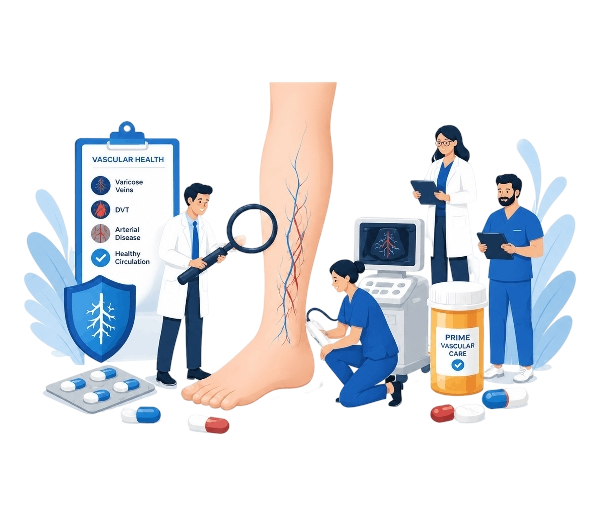
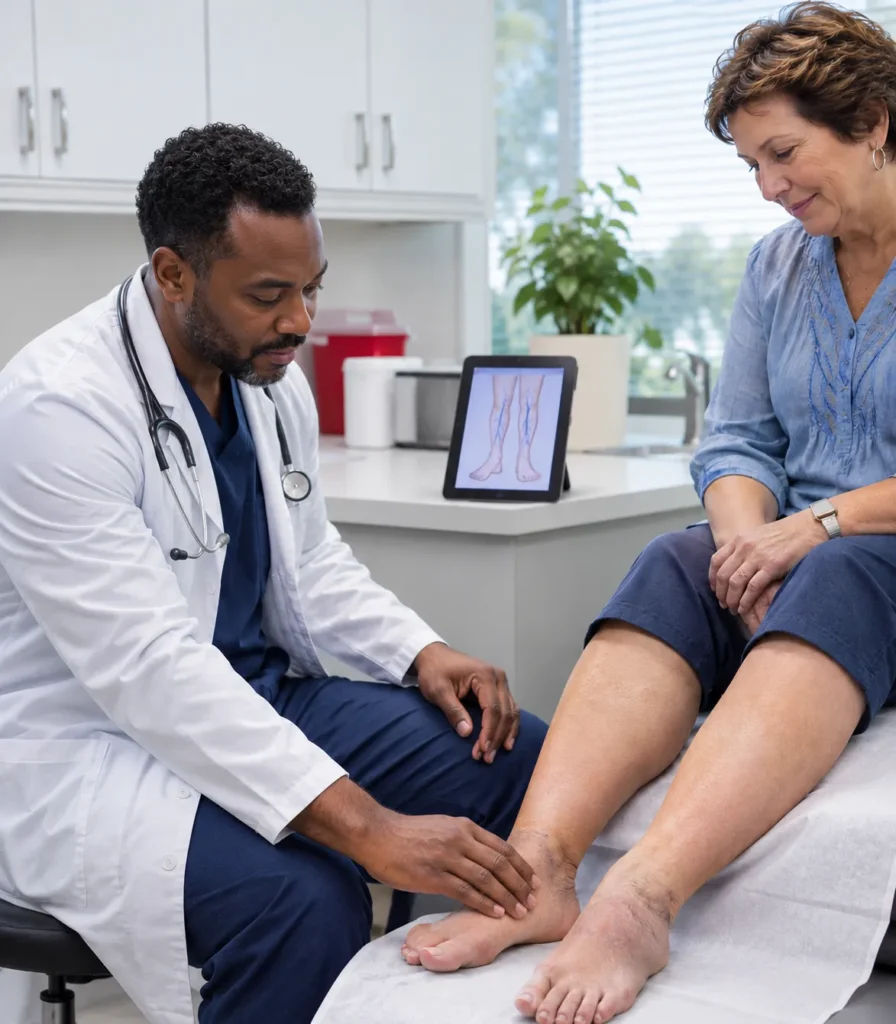
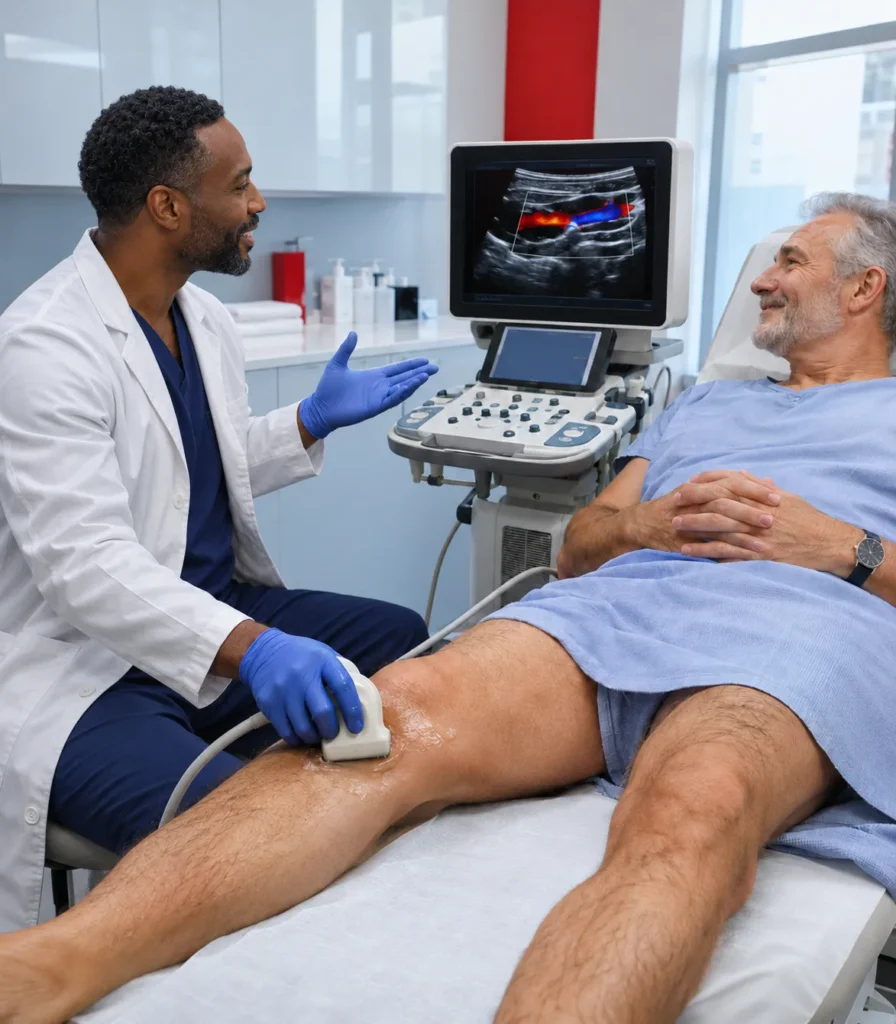


Legs that feel heavy by mid-afternoon, ankles that swell after a long day at the desk and veins that grow more visible each year are common signs of a circulation problem. These symptoms rarely improve on their own. At Prime Vascular Care, a board-certified vascular surgeon evaluates and treats the full range of vein and artery conditions, providing everything from varicose vein treatment in Tysons and spider vein care to the management of blood clots and arterial narrowing. Each treatment plan begins with an accurate diagnosis and reflects what your vascular system actually shows.
Aching Legs
Leg Heaviness
Swollen Ankles
Night Cramps
Leg pain, swelling and visible veins can indicate different underlying vascular conditions. Aching that worsens throughout the day but improves when the legs are elevated often suggests venous insufficiency. In contrast, calf cramping that begins while walking and subsides with rest may be one of the signs of poor circulation. Identifying the underlying cause before recommending treatment is important, as addressing symptoms alone may lead to unnecessary procedures and persistent discomfort.
At our Sterling clinic, which serves patients from Tysons and Tysons Corner, every evaluation begins with a detailed review of your symptoms, medical history and risk factors such as smoking, diabetes, prior blood clots and family history. A focused physical exam checks pulses, skin changes and swelling patterns, and noninvasive testing such as the ankle-brachial index or duplex ultrasound confirms what the exam suggests.
Only once the cause is clear does the board-certified vascular surgeon recommend treatment, whether that means compression and monitoring, a minimally invasive procedure or surgical repair.
Detailed symptom and risk factor review at your first visit
Physical exam and noninvasive testing to confirm the source
Treatment recommended only after the diagnosis is confirmed
Patients from Tysons come to Prime Vascular Care for conditions ranging from common vein problems to arterial disease that requires surgical expertise. Every care plan starts with a confirmed diagnosis rather than a standard template.
Many vascular conditions cannot be confirmed by appearance alone. A leg that looks normal may have a failing valve where the great saphenous vein meets the deep system. Swelling around the ankle may reflect reflux in several vein segments, and a slow-healing wound on the foot may point to an arterial blockage that a physical exam cannot detect.
For this reason, your vein specialist at Prime Vascular Care performs a duplex ultrasound during the first visit. This non-invasive scan combines standard imaging with Doppler flow measurement to show the direction and speed of blood moving through your veins and arteries. The results identify where circulation is compromised and give the surgeon the information needed to recommend an appropriate treatment path.
Each finding is explained before you leave, along with the options that fit your condition.
Duplex ultrasound performed in-office during your first visit
Identifies venous reflux, valve failure and arterial narrowing with precision
Results explained in clear terms before you leave the clinic
Every recommendation is based on what the imaging shows
Beyond varicose vein treatment in Tysons Corner, Prime Vascular Care offers advanced vascular care for joint, vein and artery conditions, with each plan designed around your diagnosis.
Chronic knee pain from osteoarthritis is partly driven by inflammation in the joint lining, which develops an abnormal supply of small blood vessels. Genicular artery embolization is a minimally invasive procedure that reduces blood flow to these vessels to ease pain without surgery or a joint replacement. Through a small puncture in the leg, the surgeon guides a thin catheter to the genicular arteries and releases microscopic particles to block the targeted branches. As a form of musculoskeletal embolization, it suits patients with moderate to severe knee pain who have not found lasting relief from medication, injections or physical therapy.
Outpatient procedure with no surgical incision
Option for patients not ready for knee replacement
Many patients report pain relief within the first few weeks
Imaging review to confirm candidacy before treatment
Deep vein thrombosis is a blood clot that forms in a deep vein, most often in the calf or thigh. The CDC estimates that DVT and pulmonary embolism affect up to 900,000 people in the United States each year. Warning signs of blood clots in the leg include one-sided swelling, pain, warmth and redness. The surgeon confirms the size and location of the clot with duplex ultrasound and determines the appropriate DVT treatment, which typically involves blood thinners for at least three months. Recovery is monitored closely to lower the risk of recurrence and long-term vein damage.
Emergency: Sudden shortness of breath, chest pain or coughing up blood may indicate a pulmonary embolism. Call 911 immediately.
Same-day evaluation available for suspected DVT
Duplex ultrasound to confirm clot location and extent
Structured follow-up to reduce the risk of post-thrombotic syndrome
Guidance on compression, movement and ongoing care
The carotid arteries in the neck carry blood to the brain. When plaque narrows these arteries, a clot or plaque fragment can break loose and block blood flow to the brain, making carotid artery disease a leading cause of ischemic stroke. The condition often has no symptoms until a stroke or transient ischemic attack (TIA) occurs. A carotid duplex ultrasound measures the degree of narrowing. Treatment ranges from medication to procedures such as carotid endarterectomy and TCAR surgery, which temporarily reverses blood flow during stenting to protect the brain from debris. Learn more about carotid artery disease treatment.
Emergency: Sudden weakness or numbness on one side of the body, trouble speaking or sudden vision loss in one eye are warning signs of stroke. Call 911 immediately.
Carotid duplex ultrasound to measure narrowing
Medical management with antiplatelet and cholesterol therapy
Minimally invasive TCAR for eligible patients
Ongoing imaging to monitor stability
An abdominal aortic aneurysm is a weakened, enlarged section of the aorta, the body’s largest artery. Most aneurysms grow slowly and cause no symptoms, so many are found only through screening. The U.S. Preventive Services Task Force recommends a one-time ultrasound screening for men ages 65 to 75 who have ever smoked. Smaller aneurysms are monitored with regular imaging, and repair is generally recommended once an aneurysm reaches about 5.5 cm in men or 5.0 cm in women, or when it grows rapidly. Options for abdominal aortic aneurysm treatment include minimally invasive endovascular repair (EVAR) and open surgical repair.
Emergency: Sudden, severe abdominal or back pain with dizziness may signal a ruptured aneurysm. Call 911 immediately.
Ultrasound screening and size-based surveillance
Risk factor management for blood pressure and smoking
EVAR through small groin incisions for eligible patients
Lifelong imaging follow-up after repair
Dr. Akinrinlola is a board-certified vascular surgeon with experience in both hospital and outpatient settings. He earned his medical degree at Howard University, completed his general surgery residency at Howard University Hospital and trained in vascular surgery at Virginia Commonwealth University. His clinical focus includes limb salvage, carotid interventions, peripheral vascular procedures, dialysis access and aneurysm repair, using both open and minimally invasive techniques. Patients from Tysons often note that he takes the time to explain each diagnosis and treatment option clearly before moving forward.
Imaging is completed during your first appointment. Most patients leave with a confirmed diagnosis, a treatment recommendation and a scheduled next step, without an extended referral chain.
The same board-certified surgeon reviews your ultrasound, explains the findings and performs your treatment, which keeps your care consistent from evaluation through recovery. The clinic also serves nearby communities, including Vienna, Reston and Fairfax County.
Every treatment plan includes scheduled follow-up imaging, outcome tracking and clinical adjustment when recovery requires it. Patients who travel from Tysons are entering a care relationship that lasts until their condition is fully addressed.
I was dealing with varicose veins for years, and the pain had started to affect my daily life. I came across Prime Vascular Care and I’m so glad I did. Dr. Akinrinlola and his team were incredibly thorough in explaining my treatment options. The procedure was quick and nearly painless, and I’ve noticed a huge difference in how my legs feel. I’m finally able to enjoy activities I couldn’t before. Highly recommend Prime Vascular Care to anyone needing vascular treatment in Virginia!
After being diagnosed with deep vein thrombosis, I was worried about my future health. Dr. Akinrinlola explained everything clearly and gave me confidence that I was in great hands. The team at Prime Vascular Care not only treated my condition effectively but also made me feel supported every step of the way. I’ve since made a full recovery and can’t thank them enough for their expert care.
I had been suffering from peripheral artery disease for some time, and I felt like I had no options left. Prime Vascular Care was recommended to me, and I’m so grateful I made the appointment. The treatment plan was tailored to my specific needs, and Dr. Akinrinlola’s expertise really put me at ease. My circulation has improved dramatically, and I feel so much better. I can walk without pain again, and it’s all thanks to the excellent care I received.
I was referred to Prime Vascular Care for an abdominal aortic aneurysm, and I was nervous about the procedure. Dr. Akinrinlola took the time to explain everything in detail, and his confidence really helped calm my fears. The surgery was a success, and I’m now recovering well. I can’t express how much I appreciate the professionalism and kindness of the entire team. They truly care about their patients’ well-being.

Visible or bulging veins, leg aching or heaviness, ankle swelling, skin discoloration near the ankle or a sore that will not heal are all reasons to see a vein doctor. Patients in Tysons Corner who notice these signs benefit from early evaluation, when more treatment options are available.
Leg vein treatment depends on the ultrasound findings. Options include endovenous laser therapy to close a faulty vein, sclerotherapy for spider veins and smaller varicose veins and microphlebectomy to remove surface varicose veins through tiny incisions. All are performed in-office under local anesthesia.
Many patients seek this treatment for appearance, but spider veins can also be a visible sign of venous reflux beneath the skin. A duplex ultrasound determines whether an underlying vein problem needs treatment before or alongside sclerotherapy.
The vascular surgeon reviews your symptoms and medical history and performs a duplex ultrasound in-clinic. Your findings and treatment options are explained before you leave.
Our clinic is at 21475 Ridgetop Circle in Sterling, VA, a direct drive from Tysons via VA-7 (Leesburg Pike) or the Dulles Toll Road (VA-267). Travel time depends on the route and traffic.
At Prime Vascular Care, we prioritize your well-being with compassionate, patient-centered treatment and clinical excellence.
Quick Links
Treatments
Dr. Akinrinlola is a highly skilled, board-certified vascular surgeon with extensive experience in both hospital-based and outpatient settings. Specializing in comprehensive vascular care, he has a particular focus on limb salvage, carotid interventions, peripheral interventions, dialysis access, and aneurysmal repair. His clinical expertise covers the full spectrum of vascular and endovascular procedures.
He earned his medical degree from Howard University, completed his general surgery residency at Howard University Hospital, and pursued a vascular surgery fellowship at Virginia Commonwealth University. Dr. Akinrinlola holds dual certifications from the American Board of Surgery and the American Board of Surgery/Vascular Surgery. He is an active member of the Society for Vascular Surgery and the American College of Surgeons.
Beyond his dedication to medicine, Dr. Akinrinlola embraces a well-rounded life enriched by his love of travel, soccer, and music. Whether exploring new destinations, enjoying a match on the field, or immersing himself in diverse musical genres, he brings passion and curiosity to all his pursuits.
Committed to providing compassionate, patient-centered care, Dr. Akinrinlola is devoted to improving vascular health and serving the Northern Virginia community.