

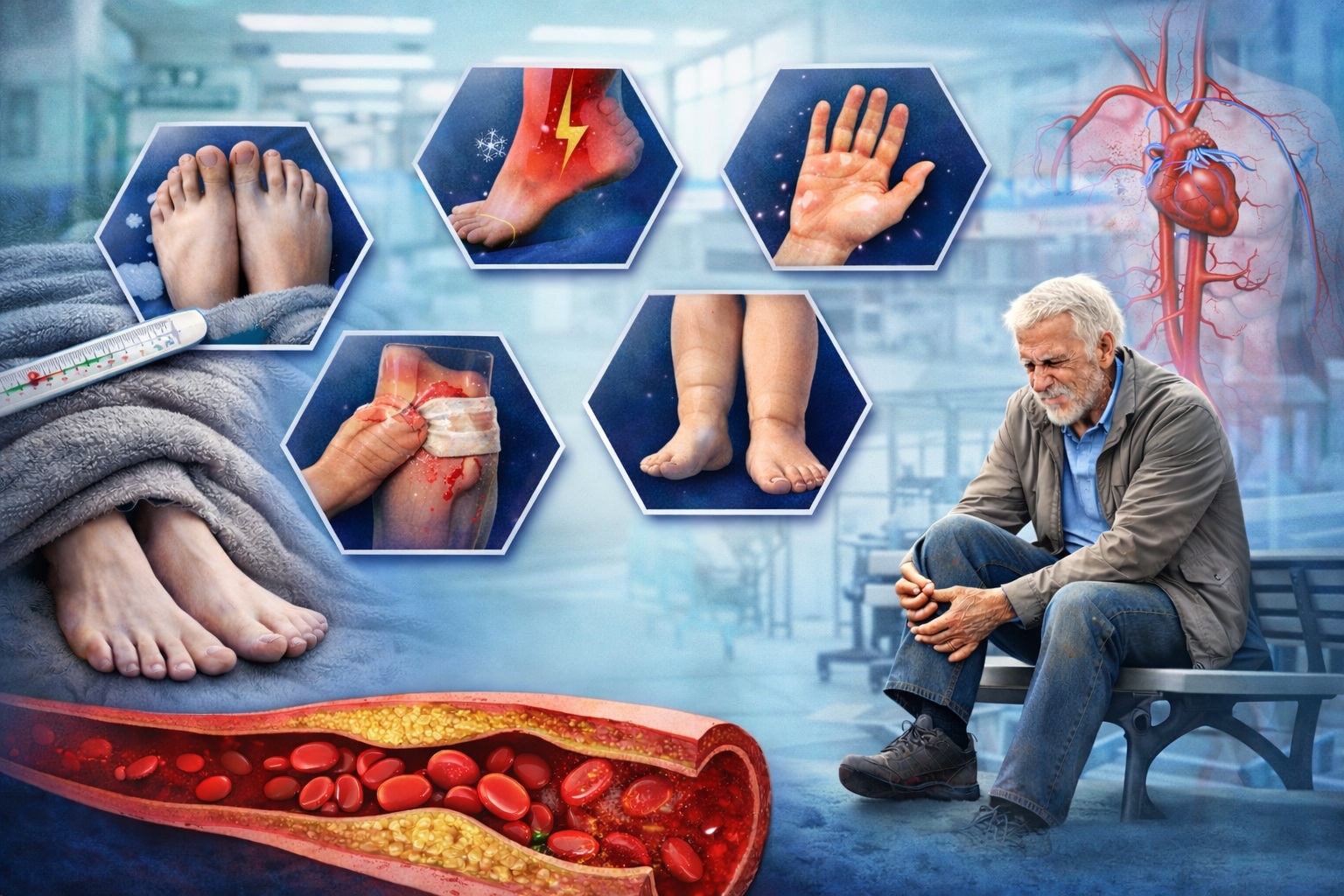
Nobody wakes up thinking “today’s the day I check my circulation.” But your body sends pretty clear signals when blood isn’t flowing right.
Maybe you’ve been brushing off cold feet just winter. Or leg cramps from that new workout. The truth? These could be warning signs in your circulatory system.
Poor circulation doesn’t announce itself dramatically. It sneaks up through symptoms most people dismiss. What begins as minor discomfort can snowball into peripheral artery disease or blood clots. The good news? Catching these signs early opens up straightforward treatment options.
Your Hands and Feet Stay Cold
You layer on thick socks. Grab another blanket. Turn up the heat. But your feet still feel frozen.
This isn’t temperature sensitivity. When extremities stay noticeably colder than your core, blood isn’t reaching them properly. Some people see fingers turn pale or bluish. Others describe a “disconnected” feeling in their feet.
Why this happens
Narrowed arteries create traffic jams. The further blood travels from your heart, the harder the journey when vessels are compromised.
Treatment that works
Specialists pinpoint exactly where circulation is blocked using non-invasive imaging. Treatment includes medications that relax blood vessels, angioplasty procedures using tiny balloons to widen arteries, or stent placement. For significant blockages in peripheral arterial disease, atherectomy removes plaque directly.
Most PAD treatments wrap up in under an hour. Patients typically feel improvement within weeks.
Walking Triggers Leg Pain
You’re fine sitting. Start walking and within a block your calves ache. The pain builds. You stop. Rest. Pain fades. Same cycle repeats.
That’s claudication. Your leg muscles aren’t getting enough oxygen when you move. Your calf muscles need more blood during exertion. Narrowed arteries can’t deliver. Muscles cramp from oxygen starvation.
Here’s what bugs me: people hear “that’s just aging” and accept it. Vascular specialists will tell you flat out: it’s not.
Getting you walking again
Supervised exercise therapy helps your body build new blood vessels around blockages. Medications prevent clots while improving flow. For blocked arteries, endovascular procedures use catheters through small incisions. Severe cases might need bypass surgery.
Random Numbness Shows Up
Your foot falls asleep when you sit wrong. But this is different. Numbness or pins and needles appearing randomly in your hands, feet or legs without obvious reason. Happening repeatedly.
Decreased blood flow starves your nerves. They start sending confused signals. Burning. Prickling. Complete numbness. This issue deserves urgency because nerve damage resulting from poor circulation can be permanent.
How treatment reverses this
Vascular ultrasound maps exactly where blood flow is choked off. Balloon angioplasty stretches narrowed vessels. Stenting adds structural support. Medication prevents further narrowing.
Act while nerve damage is still reversible.
Wounds Won’t Close
A small scrape on your foot should heal in two weeks. But yours? Still open a month later. Cuts become persistent sores. Minor injuries turn into infections that won’t quit.
Hair stops growing on your lower legs. Toenails thicken or get brittle. These all point to tissue not getting enough blood.
Your body is amazing at repairs when it has what it needs. Blood delivers oxygen, nutrients and infection-fighting cells to wounds. Cut off circulation and healing stops. Non-healing wounds can escalate to serious infections.
Restoring blood flow
Chronic Wound care treatment focuses on bringing circulation back first. Revascularization procedures restore blood flow. Hyperbaric oxygen saturates tissues. Specialized dressings protect while promoting regeneration.
Vascular surgeons specializing in limb salvage use techniques to save legs and feet. Circulation first, healing second.
Your Legs Swell
Ankles puff up by dinnertime. Press your shin and it leaves an indent. Legs feel heavy. Tight. Sometimes you see veins bulging under your skin.
Tiny valves inside leg veins keep blood flowing one direction back to your heart. When those valves fail, blood pools. That pooled blood creates pressure. Pressure pushes fluid into surrounding tissue.
The actual risk
Swelling seems cosmetic. But pooled blood leads to venous ulcers and dangerous clots. Deep vein thrombosis forms when clots develop in leg veins then break free. That’s life-threatening.
Treatment approaches
Duplex ultrasound shows exactly how blood moves through your veins. Compression therapy helps push blood back toward your heart. Vein ablation seals off damaged veins. Sclerotherapy handles smaller problem veins. Venous stenting reopens severely narrowed veins.
Most procedures happen outpatient. You’re back to normal within days.
Time to Act
Recognizing these signs matters. But recognition alone changes nothing.
Testing is straightforward. Imaging and blood flow measurements pinpoint where circulation fails. Treatment addresses root causes instead of masking symptoms. Restoring blood flow prevents complications.
Minimally invasive means tiny incisions, local anesthesia and quick recovery. Your circulation won’t spontaneously improve. But proper vascular treatment restores blood flow and prevents complications. Earlier treatment means simpler solutions.
Concerned about signs of poor circulation?
Prime Vascular Care in Sterling, VA provides comprehensive vascular evaluations to identify circulation problems early and prevent serious complications. Our team specializes in minimally invasive treatments designed to restore healthy blood flow with shorter recovery times.
Schedule a consultation to receive an accurate diagnosis and a personalized treatment plan.